MAI-KNEE™
See how the knee looks. Measure how it moves.
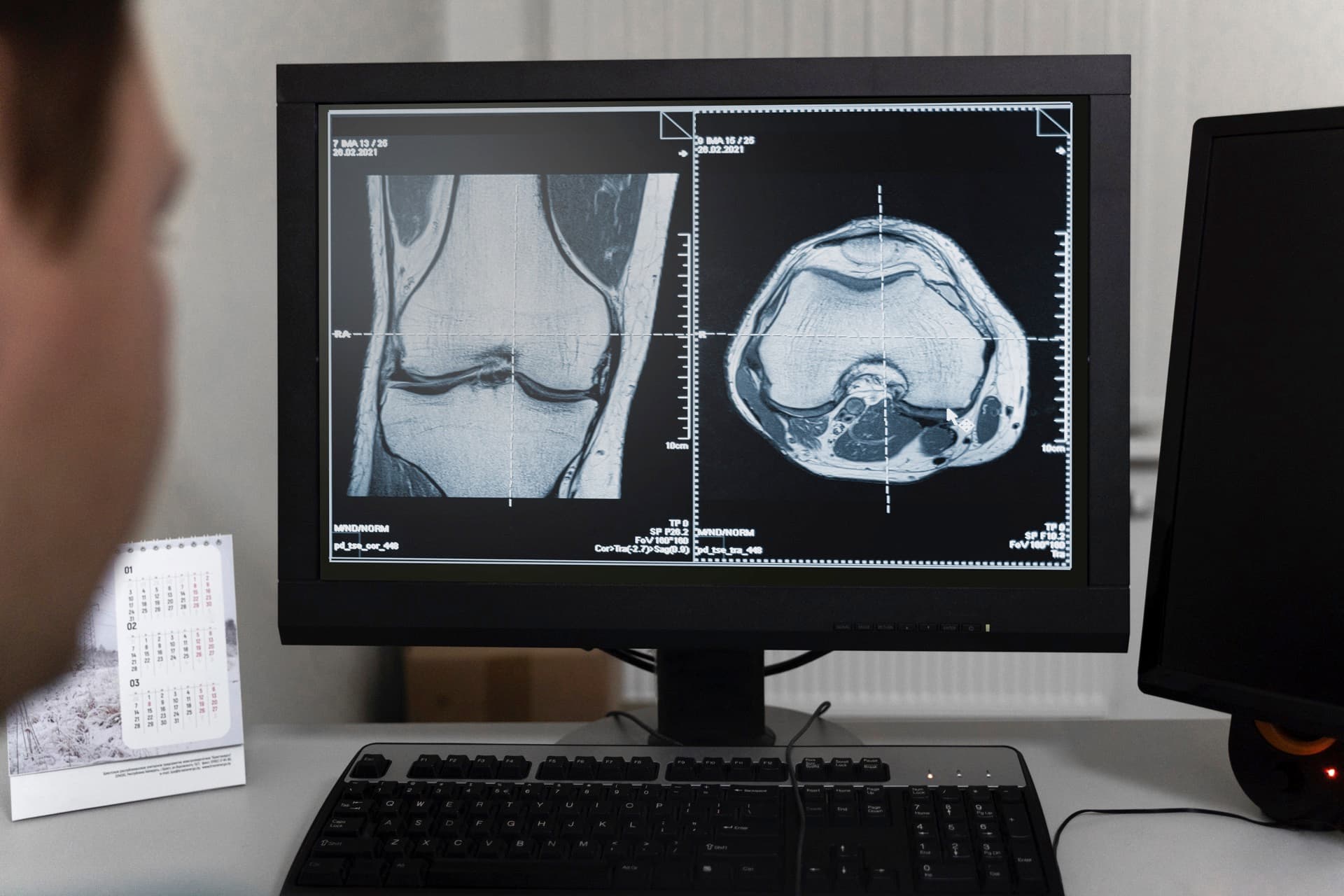
MAI-KNEE™ is a strategic multimodal AI programme designed to connect what the knee looks like on MRI with how it behaves during everyday movement.
By combining automated analysis of cartilage and meniscal features with markerless motion captured through standard cameras, the programme aims to generate interpretable digital biomarkers for earlier stratification, repeat monitoring and more personalised management of knee osteoarthritis.
MRI
Anatomical Biomarkers
3D
Markerless Motion
AI
Digital Phenotyping
The Clinical Challenge
Knee osteoarthritis is judged in still images — but lived in motion.
MRI can describe anatomy, while clinical examination and gait assessment describe function. In most pathways these signals are reviewed separately, leaving clinicians to infer how structural change relates to the way an individual moves.
528m
People living with osteoarthritis globally
365m
People affected by knee osteoarthritis globally
5.4m
People affected by knee osteoarthritis in the UK in 2020
- 01
Static anatomical assessment
MRI provides valuable structural information but records the knee at one point in time and outside everyday movement.
- 02
Subjective functional interpretation
Clinical observation can identify altered movement, but subtle changes may be difficult to quantify consistently.
- 03
Episodic follow-up
Repeated imaging and specialist assessment can be costly, inconvenient and difficult to scale.
- 04
Disconnected datasets
Anatomical imaging and functional motion data are rarely interpreted within one accessible system.
Not another scan. Not another movement score.
The unmet need is a clinically interpretable link between structure and function — one that explains how anatomical change and everyday movement relate in a single individual.
MAI-KNEE™ is an active multimodal research programme. Its proposition is the planned connection between anatomy and function — not a claim that MRI can already be replaced or that clinical outcomes have already improved.
About the Programme
What MAI-KNEE is designed to deliver
The programme extends the MAI Motion platform into a multimodal framework that can study the relationship between anatomical biomarkers and dynamic movement patterns.
Automated anatomical insight
AI-assisted analysis is intended to identify and quantify relevant cartilage and meniscal features from knee MRI.
Markerless movement capture
Standard cameras are intended to provide accessible three-dimensional motion data without a traditional marker-based laboratory.
Motion–MRI correlation
Multimodal models are designed to investigate how movement abnormalities relate to anatomical features.
Interpretable digital phenotype
The intended output is a clinically meaningful profile that supports stratification, monitoring and treatment planning.
Design Principle
Rather than asking anatomy or movement to tell the whole story alone, MAI-KNEE™ is designed to interpret them together.
A medical-software
development pathway.
The application sets out an intended medical-device software pathway involving clinical validation, human factors, secure deployment and alignment with relevant software, quality and regulatory standards.
These are development objectives. They do not establish current approval or commercial availability.
Accessible capture
Designed for video capture using standard mobile or computer cameras.
Objective quantification
Intended to convert movement into repeatable biomechanical features.
Longitudinal monitoring
Repeat assessment could support trend-based review between major imaging episodes.
Clinical integration
The proposed system is decision support for clinicians, not an autonomous diagnosis.
Strategic Importance
From separate signals to one clinical picture.
The programme is intended to create value across clinical care, research and the wider health system:
- Support earlier stratification of people with knee osteoarthritis.
- Help identify patients whose function may be deteriorating despite limited change on routine assessment.
- Reduce avoidable reliance on repeated imaging, subject to prospective health-economic and clinical validation.
- Strengthen personalised joint-preservation and rehabilitation decisions.
- Create a scalable research platform for NHS, private and academic collaboration.
Commercial & Health-System Alignment
Scalable digital deployment with clinical depth.
The proposed model combines a clinical decision-support platform with partnership and licensing opportunities across healthcare, research and medical technology.
NHS and private pathways
Potential integration into orthopaedic, radiology and rehabilitation workflows.
Subscription deployment
A software-led model designed for repeat assessment and longitudinal use.
Research partnerships
Collaboration with universities, healthcare providers and clinical-trial teams.
Technology licensing
Potential alignment with imaging, implant, rehabilitation and digital-health partners.
Programme Foundation
Clinical and project leadership
Actomed contributors included Dr Bethan Lee and Professor Paul Lee, combining governance, project delivery and orthopaedic interpretation.
AI and software
Dr Yan Wen led software development, supported by the University of Exeter's computer-vision and multimodal AI expertise.
Research infrastructure
The proposal drew on MRI, motion capture, force-platform and high-performance computing facilities.
Current Status
Part of an active innovation roadmap.
MAI-KNEE™ remains part of the MSK Doctors innovation roadmap. Development priorities include multimodal modelling, interpretable biomarkers, platform integration, clinical validation and regulatory preparation.
01
Algorithm refinement
Refine multimodal AI models and identify clinically interpretable movement features.
02
Motion–MRI modelling
Investigate correlations between anatomical and functional biomarkers.
03
Platform integration
Develop APIs, deploy models and integrate them with the MAI Motion platform.
04
Clinical validation
Evaluate accuracy, usability and clinical interpretation with patients and clinicians.
05
Regulatory and commercial readiness
Advance quality, IP, dissemination and exploitation planning.
Application-Stage Evidence Boundary
What the application does — and does not — establish.
The source document describes a proposed R&D programme and intended TRL progression. It does not confirm that the programme was funded, completed, approved or clinically deployed.
Supported by the supplied application
- A formal industrial-research application proposed an 18-month multimodal development programme.
- The concept combines AI-assisted MRI interpretation with markerless movement data.
- The application described an intended progression from TRL 4 to TRL 6.
- The proposed work packages covered algorithms, APIs, clinical validation, user input and commercial preparation.
Not established by the supplied application
- That MAI-KNEE currently replaces MRI or reduces the number of MRI scans in routine practice.
- That the system has proven diagnostic accuracy, clinical effectiveness or cost savings.
- That MHRA or UKCA approval, NHS pilots or commercial deployment have been completed.
- That the supplied application confirms an Innovate UK award or completed project.
Source provenance
- Application
- Biomedical Catalyst 2024 Round 1: Industry-led R&D
- Official title
- Advanced Multimodal AI for Digital Phenotyping and Stratification of Knee Disorders
- Lead organisation
- Actomed Ltd
- Academic partner
- University of Exeter
- Proposed duration
- Proposed 18-month industrial research programme
- Proposed maturity
- TRL 4 to TRL 6
- Source date
- 1 December 2024
No assessor score or funding outcome is stated in the supplied application.
From static imaging to dynamic intelligence
MAI-KNEE™ reflects a long-term commitment to connect biomechanics and anatomy — helping clinicians understand not only what has changed inside the knee, but what that change means when the person moves.
MAI-KNEE™ is a multimodal AI research programme described in a Biomedical Catalyst 2024 Round 1 industrial research application led by Actomed Ltd with the University of Exeter, continuing to develop within the active innovation pipeline.
Academic & Clinical Collaboration
We welcome academic, clinical, NHS and technology partners interested in multimodal knee biomarkers, prospective validation and joint-preservation pathways.