KNEE-MotionMRI
Stratifying knee osteoarthritis before the damage shows.
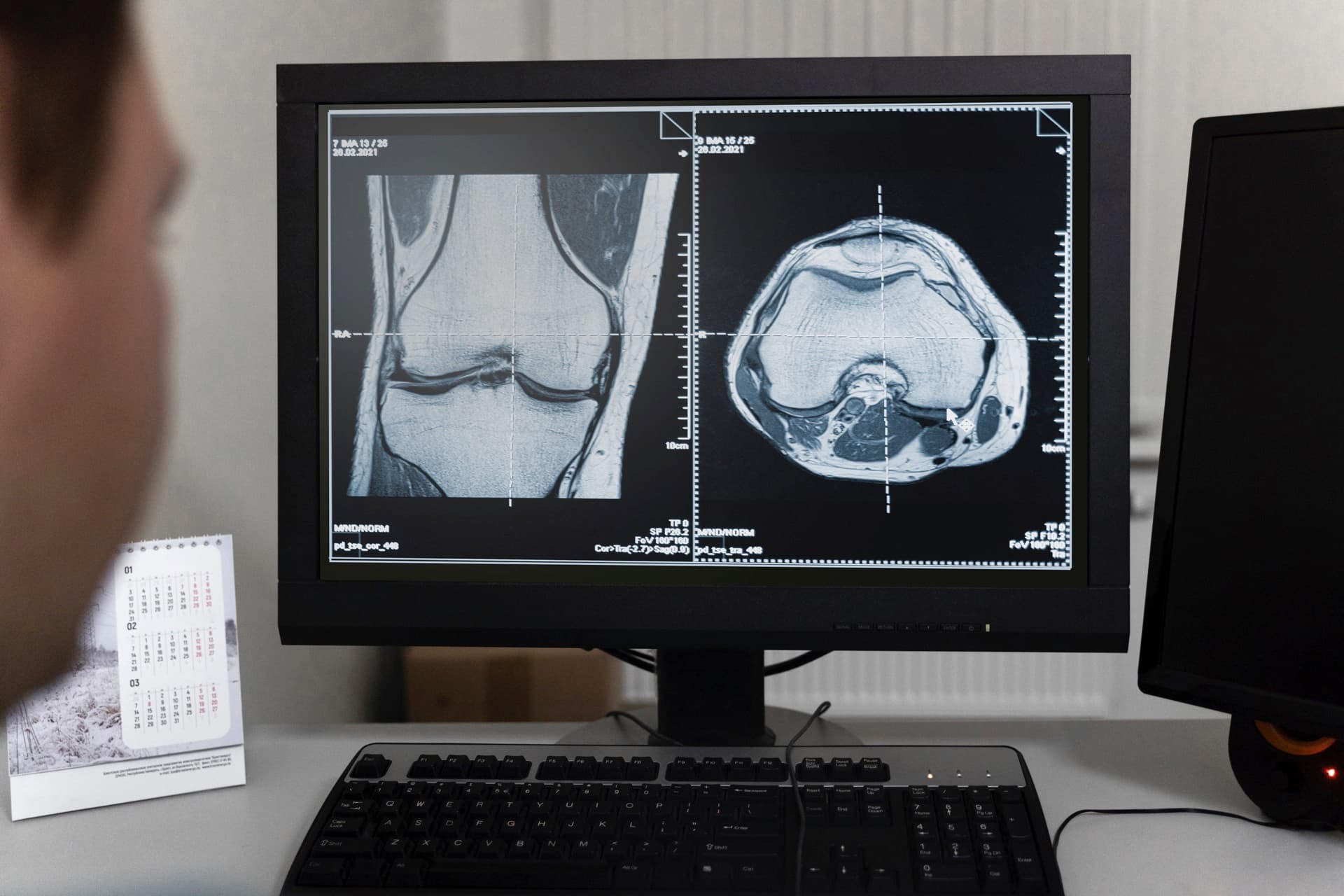
A non-invasive, clinically-driven, AI-powered platform proposed by The Keep Clinic that integrates two previously disconnected domains: real-time biomechanical motion analysis and MRI-based structural imaging.
The dual-modality approach is designed to enable earlier, more precise detection and stratification of knee osteoarthritis before structural damage occurs — delivered as an app using a mobile phone camera.
£5
Target Cost Per Scan
<2min
Personalised Report
6mo
Feasibility Programme
The Clinical Challenge
A degenerative condition, usually caught late.
Prevention and management of knee osteoarthritis focuses on healthy lifestyles and reducing joint overuse. But left untreated, it progresses to knee replacement. Current diagnostic methods rely heavily on static MRI imaging and subjective assessment that often detect the disease only after irreversible joint damage has occurred.
528m
People living with osteoarthritis globally, with knee joints most affected at 365 million
5.4m
People affected in the UK in 2020, expected to reach 6.4 million by 2030
1 in 3
GP visits accounted for by knee osteoarthritis, alongside over 100,000 knee replacements a year
- 01
Static MRI imaging
The standard tool for assessing knee soft tissues — meniscus and cartilage — but manually interpreted and captured at rest.
- 02
Subjective assessment
Often detects the disease only after irreversible joint damage has occurred.
- 03
Late-stage detection
No scalable or accessible tool captures early functional decline — instability or poor control — that precedes visible MRI change.
- 04
Long waiting lists
Untreated degeneration leads to knee replacement, with lengthy waits and major NHS expenditure.
Siloed systems, one-sided answers
Current diagnostic systems offer either static imaging or surface-level motion analysis. Nothing scalable correlates internal joint structure with external motion function — the correlation that would move screening from late-stage to early-stage.
This programme is a six-month feasibility study. Its purpose is to test whether that correlation exists strongly enough to build on, not to deliver a finished diagnostic.
The Innovation
Proprietary algorithms at three levels of the stack
Rather than relying on manually interpreted MRI results, KNEE-MotionMRI is intended to provide an objective method to quantify multi-modal data and stratify patients for faster diagnosis and more efficient treatment planning.
Computer vision
Real-time 3D motion capture from a standard smartphone camera, with no specialist equipment.
Deep learning
Motion pattern recognition and MRI feature extraction across both modalities.
Fusion layer
A novel layer synthesising functional and anatomical data into a comprehensive digital health phenotype.
Comprehensive overview
A fuller picture of a patient’s condition, accelerating early monitoring and intervention.
Affordable and accessible
Assessment conducted in patients’ homes on everyday devices, widening access for elderly and disabled patients who cannot sustain long appointments at specialist facilities.
Fewer routine scans
Reduced need for frequent MRI through earlier detection and identification of high-risk patients.
Objective quantification
Automatically detecting and quantifying structural lesions via motion, intended to increase accuracy while reducing human error.
Six Months, Four Work Packages
Delivered in-house,
at a CQC-registered clinic.
All work packages are delivered in-house at The Keep Clinic. The proposed timeline runs stakeholder interviews and clinical pathway mapping in Q4 2025, early-stage motion–MRI correlation analysis in Q1 2026, and the regulatory roadmap and technical feasibility report in Q2 2026.
WP1
£5,478
Project management and coordination
Months 1–6 · Dr Bethan Lee
Project management, risk register updates, quarterly reporting, finance claims and project meetings.
Deliverable — Kick-off report, monthly progress updates and close-out report.
WP2
£14,724
Clinical use case validation
Months 1–2 · Prof Paul Lee
Six to eight structured interviews with clinicians — GPs, first-contact practitioners and MSK specialists — and mapping of clinical pathways for knee OA triage and monitoring.
Deliverable — Clinical validation report with prioritised use cases and implementation scenarios.
WP3
£18,802
Motion–MRI correlation model
Months 3–4 · Dr Yan Wen
Explore the technical feasibility of linking motion biomarkers to structural MRI data; extract early features and correlation candidates; assess signal clarity and build early-stage hypotheses for diagnostic value.
Deliverable — Feasibility report with early correlation findings and a plan for algorithm refinement.
WP4
£9,855
Regulatory & IP roadmap
Months 5–6 · Dr Bethan Lee
Update Freedom to Operate with an external IP partner; audit GDPR and data governance procedures; map the Class I versus Class II medical device route with a draft timeline.
Deliverable — Updated FTO search and UKCA/CE strategy outline.
Delivery Capability
A clinic that already owns the equipment.
The Keep Clinic is an independent CQC-registered private medical clinic specialising in the management of musculoskeletal conditions. The team spans clinical studies, software, research, commercialisation and project management, working to a PRINCE2/Kanban methodology with agile software development.
Beyond the Project
What six months is meant to unlock.
The application positions the project as directly supporting NHS Long-Term Plan goals of early intervention and diagnostics, with these intended outputs:
- A validated clinical use case for early knee osteoarthritis stratification.
- Demonstrated motion–MRI correlation feasibility.
- A clear regulatory and IP roadmap forming the foundation for long-term clinical impact.
- Positioning for a seed-stage investment round to expand into hip and spine modules and virtual MSK care.
Application-Stage Evidence Boundary
What the application does — and does not — establish.
This page describes a funding application for a feasibility study. The cost, speed and market figures in it are proposals and projections, not measured results.
Supported by the application
- A six-month, £48,859 feasibility application led by The Keep Clinic Limited, proposed to start 1 November 2025.
- The Keep Clinic is a CQC-registered private medical clinic (Provider ID 1-8692595311) with ethics approval ref 2021_7084 for data collection.
- In-kind contribution of MRI scans (valued at £450 each) and 3,500+ existing motion analyses.
- Four work packages covering project management, clinical use-case validation, motion–MRI correlation feasibility, and a regulatory and IP roadmap.
Not established by the application
- That KNEE-MotionMRI has demonstrated diagnostic accuracy, clinical effectiveness or the stated cost savings.
- That the £5-per-scan price, sub-two-minute report time or Class II device registration have been achieved in practice.
- That UKCA/CE marking, NHS adoption or commercial deployment have been completed — WP4 is a roadmap, not an approval.
- That the application was funded, or that the market and revenue projections in it have been realised.
Source provenance
- Competition
- Innovate UK Growth Catalyst Early Stage: New Innovators
- Application name
- KNEE-MotionMRI: Predictive AI Approach to Early Knee Osteoarthritis Stratification
- Lead organisation
- The Keep Clinic Limited
- Proposed start
- 1 November 2025
- Proposed duration
- 6 months
- Total project cost
- £48,859 (labour £40,716; overheads £8,143)
From late-stage detection to early screening
KNEE-MotionMRI is designed as a scalable, accessible route to earlier intervention — supporting better patient outcomes and addressing health inequalities in musculoskeletal care across the UK.
KNEE-MotionMRI is an early-stage innovation programme led by The Keep Clinic Limited and proposed through the Innovate UK Growth Catalyst competition, continuing to develop within the active innovation pipeline.
Clinical & Commercial Collaboration
The application identifies co-development partnerships with NHS Trusts and Integrated Care Boards as a priority route forward.