A Low-Cost Human Motion Analysis Method
Marker-less Motion Capture
in Knee Osteoarthritis.
The foundational study behind MSK Doctors’ motion work — comparing marker-less RGB-D capture with the marker-based Knee Kinesiography system during treadmill gait, and asking a question that shapes every measurement since: how much does the equipment change the movement it is measuring?
2
RGB-D Cameras
10–15°
Flexion Recovered
2
Walking Speeds
Why This Study Was Needed
Movement problems are common.
Objective measurement is not.
Around 15% of patients who consult a doctor in the UK do so for a movement-related issue, and knee osteoarthritis alone is estimated to affect 19.2% of adults aged 45 and over, rising to 37% of adults over 60. Yet the assessment of how someone actually moves has largely remained subjective.
Marker-based laboratory capture is treated as ground truth, but it is expensive, needs dedicated space, and takes trained staff. Cheaper alternatives exist — the Knee Kinesiography (KneeKG) system tracks infrared markers on a rigid harness around the knee — but they carry their own constraints.
Can a marker-less RGB-D system measure gait well enough for clinical use — and does removing the hardware change what we see?
Constraints of the marker-based comparator
One leg at a time
Knee Kinesiography instruments a single limb, so left-versus-right asymmetry cannot be captured in one pass.
Treadmill required
Gait must be recorded on a treadmill, which constrains where an assessment can physically take place.
15–30 minutes per patient
Marker placement takes 15–20 minutes for a trained technician, and averages 30 minutes for a clinician with limited experience.
Movement altered by measuring it
The apparatus itself changes the movement being measured — the effect this study set out to quantify.
How It Was Measured
The same walk, recorded both ways.
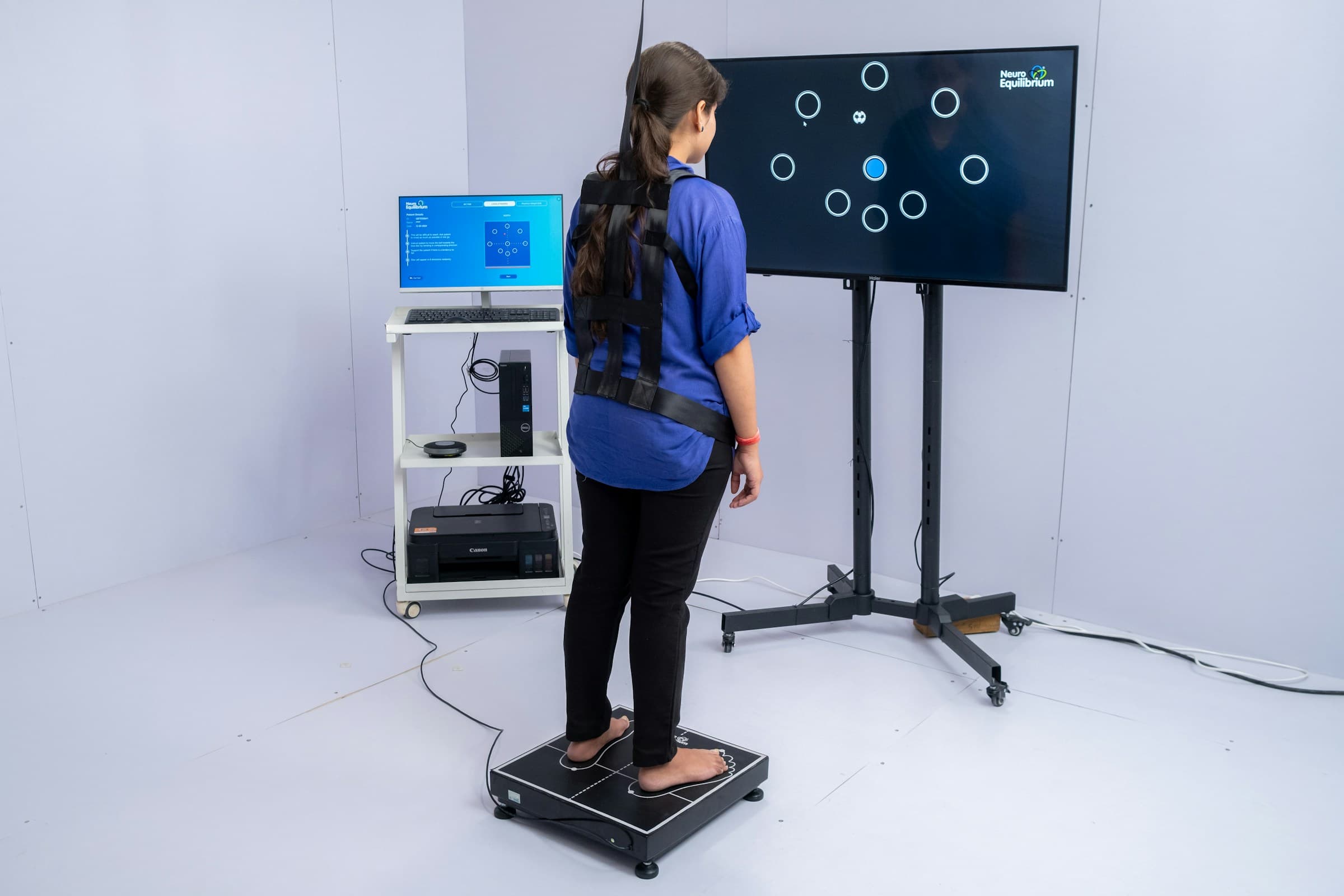
Two Azure Kinect RGB-D cameras recorded the same participant walking on a treadmill, first without any hardware on the leg and then with the KneeKG markers fitted. Because the marker-less cameras recorded both conditions, the only variable that changed was the presence of the apparatus itself.
Step 01
Acclimatise
Five minutes of treadmill walking to settle into a natural pattern and establish comfortable and fast walking speeds.
Step 02
Record marker-less
Three one-minute repeats at each speed — 3 km/h comfortable and 3.5 km/h fast — captured by two RGB-D cameras with real-time joint prediction.
Step 03
Repeat with markers
KneeKG markers fitted to the left leg, acclimatisation repeated, then the identical protocol recorded again by the same cameras.
The analysis pipeline
Joint coordinates from both cameras were registered into a single 3D skeleton, then fed to a purpose-built pipeline that derives velocity-based and angular biomechanics — knee flexion and hip abduction among them — using an adapted cosine rule across any three joint centres. Every frame produced a value, so the analysis compares whole movement patterns rather than single snapshots.
Headline Finding
The hardware was suppressing the knee.
With the KneeKG apparatus fitted, the range of knee flexion during walking fell by up to 10 degrees depending on speed — and the discussion puts the natural-movement difference at 10–15° in range of flexion. Hip abduction, measured well away from the apparatus, was essentially unchanged. Paired t-tests returned p < 0.05 for both measures.
| Measure (3 km/h) | Marker-less | With KneeKG | Difference |
|---|---|---|---|
| Knee flexion — left | 71.25° (± 6.83) | 56.97° (± 2.61) | +14.3° |
| Knee flexion — right | 77.04° (± 2.93) | 72.79° (± 1.56) | +4.3° |
| Hip abduction — left | 16.23° (± 1.20) | 16.83° (± 0.36) | −0.6° |
| Hip abduction — right | 17.63° (± 0.68) | 17.41° (± 0.37) | +0.2° |
Values are range of motion in degrees (± standard deviation), from Table 1 of the paper — a single healthy participant, three one-minute repeats per condition. Only the left leg was instrumented with KneeKG, which is why the left knee shows the larger difference.
Why this matters
If wearing the measuring device reduces flexion, then a flexion deficit recorded that way is ambiguous — pathology, or the instrument itself? Marker-less capture removes that ambiguity, and with it a source of error in every clinical decision built on the number.
What It Enables
Measurement that fits the clinic.
The practical case is as strong as the biomechanical one. A KneeKG acquisition takes 15–20 minutes with a trained technician and around 30 minutes with a clinician of limited experience. With the marker-less setup, the rig is configured once and acquisition time per patient is simply the time spent moving.
That difference is what makes repeated measurement — the same patient, month after month — realistic rather than aspirational.
Low-cost hardware
Two consumer RGB-D cameras and a single workstation replace a dedicated marker-based installation.
Fits a real clinic room
No treadmill and no minimum room dimensions — the method suits smaller clinical environments.
Repeatable over time
Setup happens once, so acquisition time per patient is simply the time spent moving — making longitudinal tracking practical.
Beyond gait
The same pipeline applies to any clinically meaningful exercise, not only walking, supporting remote rehabilitation.
What This Study Does Not Show
A first result, stated plainly.
A single participant
The comparison was performed on one healthy control, because of a limited participant pool. The authors are explicit that further research with more participants is needed, and note that the finding concerns the difference between two capture methods rather than the presence of disease.
Healthy movement, not osteoarthritic movement
The participant had no signs of movement issues. The study establishes the measurement case for clinical use in knee osteoarthritis; it does not itself report osteoarthritic gait.
One leg instrumented
Because KneeKG analyses one leg at a time, only the left knee carried the apparatus — which is precisely why the left-side difference is the meaningful comparison and the right side serves as an internal reference.
This is the earliest completed study in the MSK Doctors motion programme, and the work that followed — the motion-based biomarker study in 20 patients, and the sit-to-stand protocol validation — answers exactly the questions it leaves open.
Where the motion programme began.
Every marker-less measurement MSK Doctors takes today rests on this result: that removing the apparatus changes what you see, and that natural movement is the thing worth measuring.
Study Identity
- Authors:
- Kai Armstrong · Yan Wen · Lei Zhang · Xujiong Ye · Paul Lee
- Institutions:
- Lincoln School of Computer Science, University of Lincoln · MSK Doctors, Sleaford
- Journal:
- Journal of Arthritis 11(1), published 28 January 2022
- Licence:
- Creative Commons Attribution
Citation
Armstrong K, Wen Y, Zhang L, Ye X, Lee P. Novel Clinical Applications of Marker-less Motion Capture as a Low-cost Human Motion Analysis Method in the Detection and Treatment of Knee Osteoarthritis. J Arthritis. 2022;11(1):001-005. doi:10.4172/2167-7921.2022.11.053